Showing posts with label santo tomas. Show all posts
Showing posts with label santo tomas. Show all posts
Sunday, December 25, 2016
Tuesday, April 8, 2014
The Year That Was 2013: Christmas Tours and Celebrations
The so-called Christmas break has always been a chance to literally breathe in respite, however brief. Ever since Back Trails began, traveling has become part of this two- or three-week break. And last year was no different. Although not far, neighboring towns are always infinite sources of historical delights (for lack of a better term).

San Pablo City Plaza
From home first. The city plaza has been, in recent years, surprisingly open to the public (see one of the first entries in Back Trails which included the town plaza here: A Visit to San Pablo City Saint Paul the First Hermit Cathedral). The gates before were only open during the week-long Coco Festival during January. Last December the plaza was covered with hundred of blinking lights in celebration of the coming Christmas. I still found it somewhat surprising, seeing people stroll within this space in the middle of the city proper or seat on its stone benches.


Santo Tomas, Batangas
Bus rides have always been fun. So a bus we hailed and alighted on the town of Santo Tomas in the province of Batangas. We naturally gravitated to the town church (which I have covered before; see my entry: Afternoon Stroll in Santo Tomas, Batangas: Santo Tomas Church Part 3). Besides visiting the interior of a chapel on the side of the church, I ‘discovered’ this marker that is World War II-related, most likely missed out during my first documentation of the church due to many photo taking.


A plaque entitled ‘Memorial’ contained the following words:
On a separate plaque are the names of the sister referred to in the memorial. They were:
As I write this entry, I believe this historical event is worth studying, the story of their presence in that place and perhaps their individual biographies.


Tanauan, Batangas
A short jeepney ride would bring you to the city of Tanauan. Its church, although still modern-looking (except perhaps the elaborate designs of the door borders; I don’t know if it has a more formal term). One curious item I saw was this charcoal artwork which depicts the Tanauan church with an adjacent building, like a convento or school, I am not sure. A short review of its historical background that the location of the church dates back to 1754 and so this Spanish period structure definitely has basis. Although I am yet to see old photos of the church.


On the town’s ‘plaza’ we found a giant Christmas tree that resembles the town Christmas tree in 2012. But I cannot directly claim that they are one and the same. A short walk would bring you to an abandoned lot with a remaining wall of what could have been a big house.


What could catch your attention are the ‘stones within the paletada. I am not an expert in building materials but they appeared to me as if they are crude stones, not exactly hollow blocks. Better look at them more closely next time. This could probably be part of a big house as I have said earlier. This is probable given the fact the street on which this lone wall is found is lined with big, old houses.


Malvar, Batangas
Next stop: Malvar, a town that is yet to be ‘discovered’ by Back Trails. The town church has resemblance to the church found in Alupay, Rosario, Batangas (see my entry here: Holy Family Parish Church in Alupay, Rosario, Batangas). I have never actually slept inside a Roman Catholic Church, much more slept during a mass. But that was precisely what happened on this visit: dozed off during a wedding ceremony! But still we co-celebrated in the happy nuptials, however silent.


A marble slab outside contained the ‘Decree of Dedication’ of the church to the Immaculate Conception. Beyond this dedication, it is actually public source of the church’s history. From the decree I quote:
(The happy tour ended when that big small came into view. Companions’ shopping prospects won over further travel. Will tackle Lipa again soon.)


Christmas
I am not exactly an active participant of the so-called Christmas for reasons both academic and religious. But this event, whatever its motivations and supposed origins, gives one a glimpse of our long-acquired traditions and ways of celebrating it. Athough it cannot be denied that this holiday in the country is now heavily influenced by Western traditions, particularly American. Sad but true. History-wise, Christmas reminds me of several scenes in José Rizal’s “Noli Me Tangere” and at the same time makes you more open to the concept of giving than in any time of the year.

Once, we woke up just to get a glimpse of the morning masses held a few days before Christmas: the Misa de Gallo. It was just disappointing to see people selling cigarettes on church grounds. Catholic or non-Catholic, it was quite obvious that it was disrespectful. Pan de Sal gave way to Puto Bumbong which was eaten happily together with a large cup of milk. Add to that another set of meal later in the morning with the hard-to-get (at least in our case) tawilis.
As I close this entry, it seemed more like a truncated Visita Iglesia rather than a Christmas tour. Still, my view stands that this break should be exploited not just for unhampered shopping and arbitrary giving but also to know more of difference places in the country.
San Pablo City Plaza
From home first. The city plaza has been, in recent years, surprisingly open to the public (see one of the first entries in Back Trails which included the town plaza here: A Visit to San Pablo City Saint Paul the First Hermit Cathedral). The gates before were only open during the week-long Coco Festival during January. Last December the plaza was covered with hundred of blinking lights in celebration of the coming Christmas. I still found it somewhat surprising, seeing people stroll within this space in the middle of the city proper or seat on its stone benches.
Santo Tomas, Batangas
Bus rides have always been fun. So a bus we hailed and alighted on the town of Santo Tomas in the province of Batangas. We naturally gravitated to the town church (which I have covered before; see my entry: Afternoon Stroll in Santo Tomas, Batangas: Santo Tomas Church Part 3). Besides visiting the interior of a chapel on the side of the church, I ‘discovered’ this marker that is World War II-related, most likely missed out during my first documentation of the church due to many photo taking.
A plaque entitled ‘Memorial’ contained the following words:
“The Parish Church of Sto. Tomas de Aquino, facing the legendary Mt. Makiling, bears a historical memory of World War II-1941-1945, for on its ground men, women, and children courageously faced death with the weapons of savage warface [could probably meant to be warfare -fme] and missile of modern artillery.
“In loving memory of the fifteen (15) Missionary Sisters of the Holy Spirit who were killed during the heavy artillery barrage in Sto. Tomas, the Alumni and Alumnae of St. Thomas Academy (1920-1945), dedicate this place as a silent tribute to their work as educators and missionaries;
“To the numberless unknown men, women and children who were massacred by Japanese soldiers on the feast of Our Lady of Lourdes, February 11, 1945, the townspeople of Sto. Tomas highly remember them as harbingers of PEACE AND UNITY.”
On a separate plaque are the names of the sister referred to in the memorial. They were:
- Sr. Cesaria Arjonilla (American)
- Sr. Benedicta Diancourt (German)
- Sr. Isburga Faulstich (German)
- Sr. Passima Hartelt (German)
- Sr. Francisceta Hoerth (German)
- Sr. Ansberta Hoffman (German)
- Sr. Victimaria Jurcovic (Slovakian)
- Sr. Richarde Mzyk (Polish)
- Sr. Aloysius Meder (German)
- Sr. Celia Molina (Filipina)
- Sr. Gumberta Piebler (German)
- Sr. Placida Schofs (German)
- Sr. Cleophana Schnettler (German)
- Sr. Adelheida Unterscher (German)
- Sr. Bernia Weissert (German)
As I write this entry, I believe this historical event is worth studying, the story of their presence in that place and perhaps their individual biographies.
Tanauan, Batangas
A short jeepney ride would bring you to the city of Tanauan. Its church, although still modern-looking (except perhaps the elaborate designs of the door borders; I don’t know if it has a more formal term). One curious item I saw was this charcoal artwork which depicts the Tanauan church with an adjacent building, like a convento or school, I am not sure. A short review of its historical background that the location of the church dates back to 1754 and so this Spanish period structure definitely has basis. Although I am yet to see old photos of the church.
On the town’s ‘plaza’ we found a giant Christmas tree that resembles the town Christmas tree in 2012. But I cannot directly claim that they are one and the same. A short walk would bring you to an abandoned lot with a remaining wall of what could have been a big house.
What could catch your attention are the ‘stones within the paletada. I am not an expert in building materials but they appeared to me as if they are crude stones, not exactly hollow blocks. Better look at them more closely next time. This could probably be part of a big house as I have said earlier. This is probable given the fact the street on which this lone wall is found is lined with big, old houses.
Malvar, Batangas
Next stop: Malvar, a town that is yet to be ‘discovered’ by Back Trails. The town church has resemblance to the church found in Alupay, Rosario, Batangas (see my entry here: Holy Family Parish Church in Alupay, Rosario, Batangas). I have never actually slept inside a Roman Catholic Church, much more slept during a mass. But that was precisely what happened on this visit: dozed off during a wedding ceremony! But still we co-celebrated in the happy nuptials, however silent.
A marble slab outside contained the ‘Decree of Dedication’ of the church to the Immaculate Conception. Beyond this dedication, it is actually public source of the church’s history. From the decree I quote:
“In 1970, a new church rose on this site during the tenure of then parish priest, Msgr. Jose Aquino. Today 16 Sept. 2007, this 24th Sunday in Ordinary Time, our newly renovated altar and church are dedicated in behalf of the ecclesial community of this parish during the incumbency of Fr. Virgilio B. Hernandez, its pastor. The rite of dedication is presided over by His Excellency, Most Rev. Ramon Arguelles D.D., Archbishop of Lipa, in the presence of some priest-concelebrants. The parish community, together with the good mayor of the municipality of Malvar Hon. Cristeta Cuevas Reyes, and the parish pastoral council led by Mrs. Teresita A. Ong (President) and Mr. Elpidio Aguilera (Vice President), and guests witness the occasion and participate in the said liturgical celebration.”
(The happy tour ended when that big small came into view. Companions’ shopping prospects won over further travel. Will tackle Lipa again soon.)
Christmas
I am not exactly an active participant of the so-called Christmas for reasons both academic and religious. But this event, whatever its motivations and supposed origins, gives one a glimpse of our long-acquired traditions and ways of celebrating it. Athough it cannot be denied that this holiday in the country is now heavily influenced by Western traditions, particularly American. Sad but true. History-wise, Christmas reminds me of several scenes in José Rizal’s “Noli Me Tangere” and at the same time makes you more open to the concept of giving than in any time of the year.
Once, we woke up just to get a glimpse of the morning masses held a few days before Christmas: the Misa de Gallo. It was just disappointing to see people selling cigarettes on church grounds. Catholic or non-Catholic, it was quite obvious that it was disrespectful. Pan de Sal gave way to Puto Bumbong which was eaten happily together with a large cup of milk. Add to that another set of meal later in the morning with the hard-to-get (at least in our case) tawilis.
As I close this entry, it seemed more like a truncated Visita Iglesia rather than a Christmas tour. Still, my view stands that this break should be exploited not just for unhampered shopping and arbitrary giving but also to know more of difference places in the country.
Friday, March 2, 2012
The Miguel Malvar Shrine, Sto. Tomas, Batangas
 * General Miguel Malvar’s monument inside the Malvar Shrine compound
 * Malvar Shrine marker unfortunately vandalized by some stupid individual(s)
 * interior of the Gen. Malvar Memorial Library
If there is any person of considerable fame who ‘strikes home’ to me (exempting the Laguna boy named Jose Rizal) that would be Miguel Malvar, the well known guerrilla a fighter and leader from the province of Batangas. A long-standing plan of ours was to visit the Miguel Malvar Shrine which I had difficulty in finding (which was surprising when I finally located it; read the directions below for reference).
The Miguel Malvar Shrine definitely stands in irony in the town of Santo Tomas. Being surrounded by busy and noisy highways and roads, the shrine area is surprisingly calm, especially in the late afternoon. One can free one’s children to play in the carefully trimmed grasses and enjoy the afternoon breeze while looking up the ever majestic Mount Maquiling.
 * a bust of Malvar presented apparently during
his 100th birthday celebration
 * one of the famous photos of the already guerrilla Miguel Malvar
 * a painting of Malvar in what appears to be a Rayadillo uniform
 * an old photo of the Malvar monument
on display inside the Malvar Shrine
 * a tomb? or simply a memento inside the Malvar Shrine?
 * a wall wide painting of Miguel Malvar
  * a Katipunero bronilla of Liliw, Laguna; allegedly from the Malvar Brigade
 * a rayadillo uniform on display
As one enters the Shrine compound you will see the imposing monument dedicated to General Miguel Malvar (which some kids use as target for their pellet guns). A marker just below it reads:
“Miguel Malvar 1865-1911: Isinilang sa Baryo San Miguel, Santo Tomas, Batangas noong Setyembre 27, 1865 sa mag-asawang Maximo Malvar at Tiburcia Carpio[.] Unang nag-aral sa paaralan ni Padre Valerio Malabanan[.] Naging gobernadorsilyo ng Sto. Tomas noong 1892. Isa sa kauna-unahang sumapi sa himagsikang Pilipino laban sa mga Kastila noong 1896. Kahuli-hulihang Pilipinong Heneral na sumuko sa mga Amerikano noong Abril 18, 1902. Namatay noong Oktubre 13, 1911.”
 * an old photo of the Malvar Mansion found in San Pablo City, Laguna
 * souvenir programs from past Malvar Day celebrations
 * a painting depicting a meeting between Emilio Aguinaldo and Malvar
 * a painting depicting Malvar’s battle in Tayabas
 * books on sale in Malvar Shrine
A note adequate enough to say a few pertinent details about this hero, but not enough to expound his contributions to the critical events in Philippine history: the Philippine Revolution of 1896 and the Philippine-American War in which he figured. As I have said in an earlier blog post, there is book which is particularly illuminating with regards to Malvar’s early life and life after all those wars. The book’s title is “Miguel Malvar and the Philippine Revolution: a Biography” by Doroteo Abaya and Bernard Karganilla, and edited by Edberto Malvar Villegas.
 * the young Miguel Malvar
 * photos of Miguel Malvar’s relatives
 * facsimile of what appears to be a KKK telegram
 * a typewritten letter dated October 31, 1911
 * a telegram sent to Malvar in 1911
Inside the Shrine are treasures, ranging from painting depicting Malvar or his battles in different places in the country (understandable as one could not have possibly carry all the time a bulky equipment such as a camera), photos (related to him, his men, and during this time) and important documents related to the general himself. Too bad we were not able to meet with the officer-in-charge of the place as mentioned in other blogs.
 * an article in Manila Bulletin dated October 12, 1965 discussing who between
Malvar and Simeon Ola was the last leaders to surrender to the Americans
 * a Manila Times article dated September 27, 1962
discussing that Malvar was once the president of the Philippines
 * a Taliba article announcing the death of Malvar
 * a ticket for the Malvar Centennial Program
 * view of the town hall of Santo Tomas from the Malvar Shrine
 * a Manila Times article dated September 27, 1962
discussing that Malvar was once the president of the Philippines
 * a Taliba article announcing the death of Malvar
 * a ticket for the Malvar Centennial Program
 * view of the town hall of Santo Tomas from the Malvar Shrine
The place is devoid of any pomp, deeply reflecting the life that was lived by the General. One suggestion only would be that the newspapers on display in the shrine be scanned so that digital copies would enable them to survive the passing of the time.
 * a calming view of Mount Maquiling from Malvar Shrine
[How to go to Malvar Shrine, Sto. Tomas, Batangas: From Manila, one must board a bus bound for Lucena City, Quezon. Drop off at Jollibee Sto. Tomas near Polytechnic University of the Philippines Sto. Tomas Campus. Walk through the street just beside Jollibee until you reach Malvar Shrine found on the right side.]
Monday, January 9, 2012
The Curves of a Maiden: Mount Maquiling (Makiling)
 Ever since I first heard about Mount Maquiling (found in the province of Laguna and Batangas) shaped like a lying maiden, I have always sought to figure out the curves of that mythical woman. But up to now I am still having a hard time doing so. And so this chance shot from Santo (Sto.) Tomas, Batangas (in particular from the Malvar Shrine which I will be sharing here soon) compelled me to think longer about the mountain’s contours. At least from this view one can imagine those peaks at the left side as…her breast. Just sharing.
 Sunday, July 31, 2011
Afternoon Stroll in Santo Tomas, Batangas: Santo Tomas Church (Part 3)
 * the Santo Tomas Church façade
 * the church’s bell tower
 * general view of the interior;a mass was being held when we made this visit
I am writing this particular entry without the convenience of having notes with me; it seems that I have misplaced them. Nevertheless, a short mention on the church in an earlier entry should suffice (see it here).
 * the church’s baptistery
 * a chandelier
 * detail of the floor tiling on the church’s entrance
 * the high wall and high window
 * Trailer Pransis and sister who is now
starting to copy my style, branding herself Prenchie
 * the dark clouds parting after a brief shower of rain
 * a close up view of a statue on top of a structure adjacent to the church
 * first shot: a rainbow after the rain
 Although the structure itself is recently made, the church ’s place speaks of many stories. For one, a school is found adjacent to it, a set-up that is traced back to the Spanish time. Also, despite the wide jurisdiction of Santo Tomas, the church is built in this particular place for several possible reasons: 1) it is close to the foot of Mount Maq uiling, 2) for easy access to the administering Spaniards.
 * men with their staff;
below the statue on the foreground is the following citation:
“July 26, 1927 Sadosta: In Honor of Sister A. Ann,First Principal of St. Thomas Academy”
 * the blooming fire trees outside the church
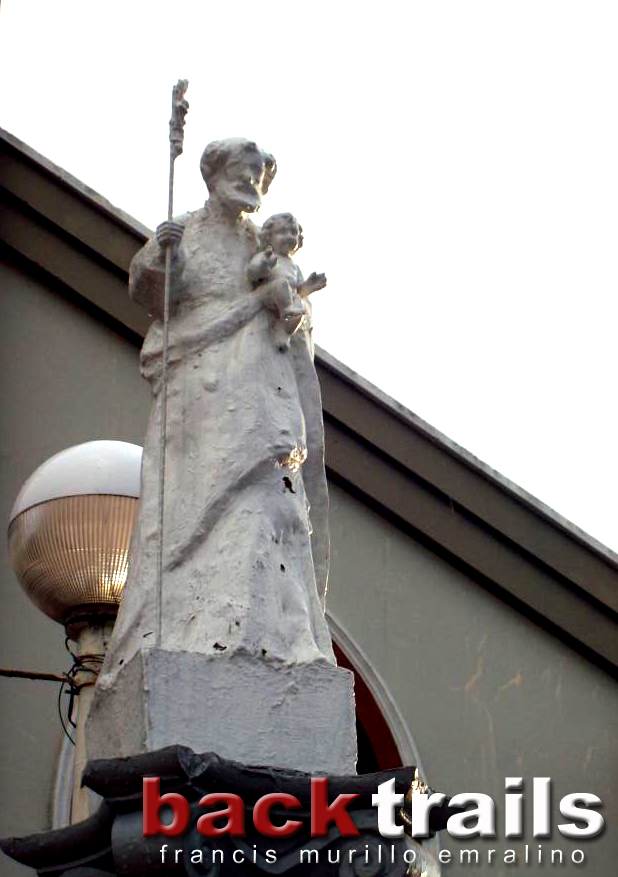 * another statue with a staff found outside the church


 * an old, cracked bell of the Santo T omas church;
casted most probably in 1894 as can be seen on the engraving on the bell itself
(I wonder if UST Archivist Regalado Trota Jose as already studied the bells of Batangas)
 * the church’s intricately detailed retablo
 * a side altar
On a more popular note, the church is the place where the wedding of Senator Tito Sotto and his wife was secretly (or was it hastily?) held. Recently, they went back to the place to renew their vows. [A disclaimer: this note must not, in any way, be taken as a sign that I am into the show business. I remembered these details as it concerned the c hurch.]

* saints by the window
 * a few lingering devotees after the mass
 * view of the altar inside the Chapel of the Blessed Sacrament
 * a taclobo: most likely donated by the Cursillitas of Santo Tomas, Batangas
 * St. Thomas Aquinas
 * the center aisle
[How to go to Santo Tomas, Batangas Church: From Manila, one can board a bus bound for Lucena or Dalahican (in Quezon Province). Such buses can be found along EDSA Kamuning and at the bus terminal at Gil Puyat LRT Station along Taft Avenue. For easy descriptions, you can just tell the bus conductor to drop you off at the Sto. Tomas public market. From there you can hail a tricycle to take you to the town church. But be wary as some tricycle drivers tend to overcharge those who they see as town tourists. Alternatively, you can just drop off at Jollibee Sto. Tomas, found a few meters before you reach the public market. There is a street on the store’s side and one can follow the street up to the PUP-Sto. Tomas Campus. The church is actually not far from the said school.]
Subscribe to:
Posts (Atom)