Showing posts with label kalayaan. Show all posts

Saturday, May 11, 2013

Revisiting the Town of Kalayaan, Laguna

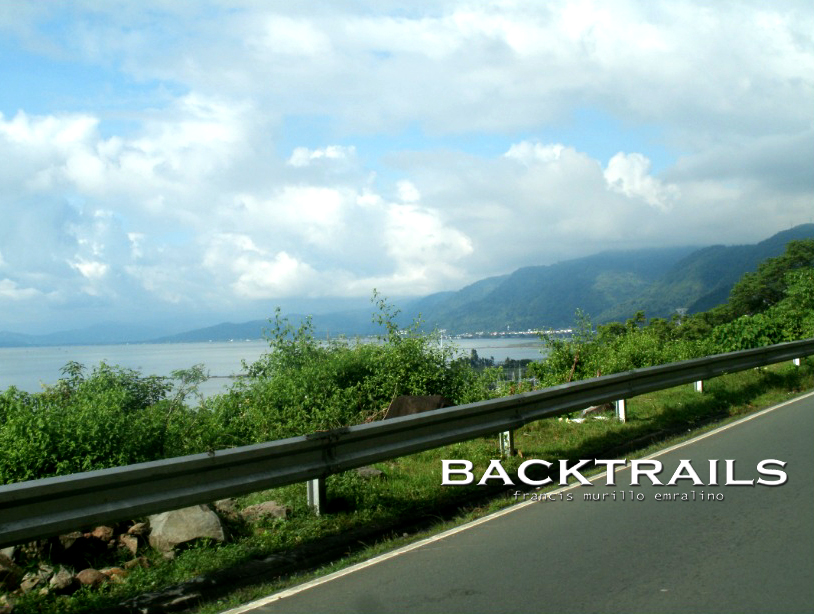
 * on the road to Kalayaan 


 * the church in Kalayaan
 
 * Pransis taking a breather

Part of our weekend trips was a revisit to Kalayaan, Laguna. We visited this lakeshore town a few years back and it was good to do so again because our camera during that first visit was not very good. To have this chance to capture the details of their church was a welcome. One curious thing that I have observed in these two visits was that the church never seems to fit in the camera screen.
  
* welcome arch 
  
 
* the church grounds  

* view of the mountainous part of the town 
 

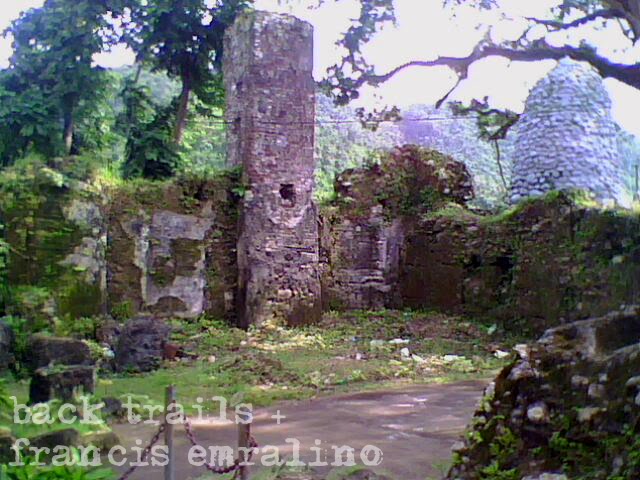
My notes about the town are rather sketchy. I am particularly interested with the historical background of that church. There seem to be ruins of sort on the church grounds, not to mention a small, nameless grave.
 
 
* behold, a sumpak!

What’s good about these provincial towns is that they are able to keep intact some of the traditions we already have. A chance encounter with a child with a sumpak or a makeshift gun/firearm made me realize that there many things that the present generation especially the simplest of things we may now find too trivial.


Read about our first visit to Kalayaan at: "A Short Visit to Longos, Kalayaan, Laguna"

Sunday, January 9, 2011

A Short Visit to Longos, Kalayaan, Laguna

* the church in Kalayan named for San Juan Bautista

* the church’s bell tower

* view of a side altar, I managed to take this shot by forcing the lens into a slit on the church’s side door

The name Longos first came to my attention when a war veteran who I interviewed provided me with some documents detailing their movements as members of HUKBALAHAP. (And I tell you dear reader; nothing beats hearing stories about World War II from the people who have lived through those tumultuous times.) It kept me thinking where exactly in Laguna were Longos and San Antonio.

A few months ago, while reading through a promotional poster about Laguna, there it was, a note about Kalayaan, Laguna, where Longos and San Antonio is found!

After having a fulfilling visit to Paete, I could not resist the temptation to make a short visit to Kalayaan, at least to its church. It is said that the town has three churches, but I think the one we visited (found on the shore of Laguna de Bay) is more known and more frequently visited.

* an unnamed grave? probably of a child? I wonder; or perhaps just a small memorial?

* ruins of what could have been a big structure; found just beside the church

* a grotto found on the entrance gate of the church

Looking up this centuries-old church, it is already a wonder that it has managed to survive the passing of times given its proximity to a body of water. Weather could have effectively worn it down. But there it was, the façade and bell tower standing strong. The ceiling (as seen from outside for the church was close when we did our visit) however was obviously recently constructed. Searching on the internet for notes and other info about the town, I found out that the typhoon Milenyo caused the destruction of the ceiling. The ceiling is just temporary and more work is to be done to repair them.

The surrounding place is composed of residential houses. There was an open area that can accommodate small gatherings or meetings. Adjacent to it was a Social Hall, an old one it seemed to me, but already in the process of demolition. Too bad my photo of the hall got corrupted when I extracted tje photos from the defective memory card we used.

Sites yet to see in Kalayaan: the two other churches and the Twin Falls. We skipped a visit to Exotic Restaurant because of budgetary limitations. It is also unfortunate that a photo of this famous and controversial restaurant got corrupted too. May be next I’ll be able to share some things about the restaurant and the food they serve there.

[How to go to Kalayaan, Laguna: From Manila or Calamba, board a bus bound for Sta. Cruz, Laguna via Calamba and College. Drop off at Pagsanjan (where most of the bus stations are found) and hail a jeep bound for Siniloan. Ask the driver to drop you off at Longos, if you are interested in visiting the church. The church is just a short walk from Exotic Restaurant which is also found in Longos.]

Monday, December 27, 2010

Revisiting Pagsanjan, Laguna

We recently did a four-town tour here in Laguna: Paete, Kalayaan, Lumban, and Pagsanjan. Pagsanjan was not in our list actually but the place was simply irresistible. Besides, visiting three towns in a day was already a tiring activity; Pagsanjan was certainly a good place to rest…and sip a cup of coffee.

Another motivation for revisiting Pagsanjan was a comment posted on one of my Pagsanjan entries. In it, someone suggested to me that I visit Mabini Street. It turned out that Mabini Street was just the street adjacent to Rizal Street, the one I have recently blogged about. The revisit was worth it.

[I will just share two finds here, as we were primarily in need of a comfort room and a place for rest when we arrived in Pagsanjan.]

* standing against the fiery sun

A Curious Obelisk

I did not notice this solitary monument until I took a picture of a statue of Father Pio on the far side of the Pagsanjan church’s patio. It seemed at first that it was a monument for Rizal. But no; he has his own at the town plaza. Neither did it look like a monument for World War II veterans. They have their own at the town plaza too.

And so I contented myself in observing the inscriptions on its base. I noted two plaques bearing the following words:

MORET CREADOR _ _ _ AS JUNTAS DE REFORMAS ULTRAMARINAS 1869
and..
MAURA AUTOR DEL R.O. DE 19 DE MAYO 1893.

Using an online English-Spanish translations program, these can be translated roughly as

MORET CREATOR _ _ _AS BOARDS OF REFORMS OVERSEAS 1869
and…
MAURA AUTHOR OF THE R.O. OF 19 OF MAY 1893

Who are these people and what are those boards mentioned are topics that can be studied next.

* the Pagsanjan Municipal Building, again!

The Pagsanjan Municipal Building

Alas, I was able to take some notes about the town’s municipal building. It was erected in mid-19th century and originally accommodated the Tribunal del Gramio de Naturales. Key points in our history saw the building’s occupation: first by the Filipino revolutionists in 1898 (Philippine Revolution of 1896), then by the American Forces in 1903 (Filipino-American War). The first public high school in Laguna was founded there in Pagsanjan and it served as its building from 1903-1907. It was most likely under the influence or administration of the Americans (or American educators for that matter). Then it also housed the town’s elementary school until 1911. Later, it became the office of the municipal government. The tumultuous times of World War II resulted in its destruction on March 20, 1945. The building’s reconstruction spanned four years: from 1951 to 1955.

---

Again, what remains to be seen in this town is the Pagsanjan Falls.