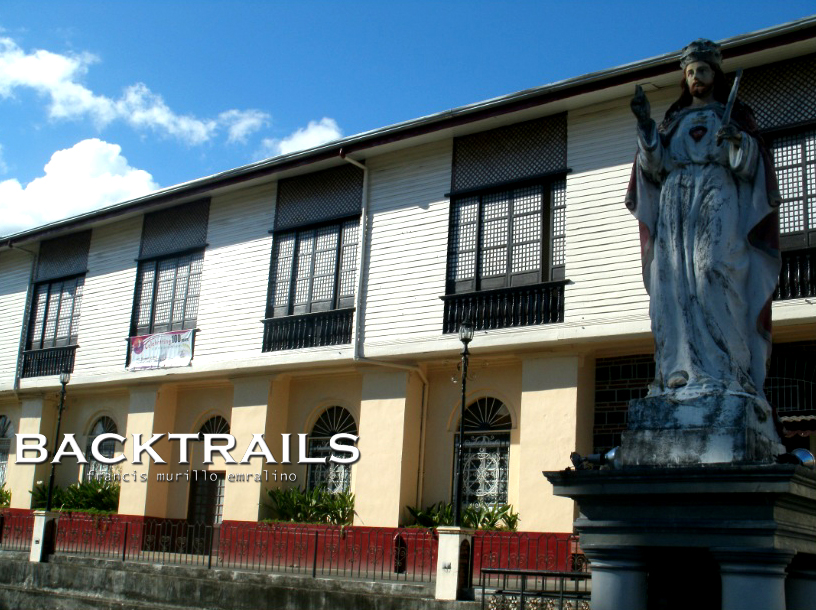
This year-end travel in Sariaya, Quezon has cemented this desire---yes,
desire---to acquire an old house. Not necessarily a heritage house (that’s
too lofty for me) but hopefully one from the Spanish or American
period. Breathing in the past each day, in a way. Enables one to learn a thing or two about the past at your own pace. Hopefully I can.
Showing posts with label sariaya. Show all posts
Saturday, January 3, 2015
Thursday, January 1, 2015
Notes on the Revered Mahal na Señor Santo Cristo de Burgos
Notes found here can be found on a wall inside the Saint Francis of Assisi Church, Sariaya, Quezon. Let the story itself come from the religious and people of Sariaya.
“Para sa kapurihan ng Poong Maykapal at sa karangalan ng kanyang lingkod na si San Francisco ng Assisi Titular ng Simbahang ito at Patron ng Parokya ng Sariaya. Ang gusaling ito ay ikinonsagra bilang simbahan ng sambayanang Katoliko ayon sa Ritu ng Concilio Vaticano II. Ginampanan ng Kagalang-galang na Monsenyor Ruben T. Profugo D.D. Obispo ng Diyosesis ng Lucena sa pakikiisa ng sambayanang Katoliko ng bayan ng Sariaya sa pangunguna ni Rdo. P. Luis R. Allarey Paroko noong 7 Setyembre 1985.”
Decree
Diocese of Lucena | Sentro Pastoral ng Diyosesis | Lucena Diocesan Compound | Isabang, Lucena City, Philippines
“In response to the call of the Church to provide the faithful and the pilgrims the means of salvation abundantly by sedulous proclamation of the word of God, by suitable encouragement of liturgical life, especially by the celebration of the Eucharist and penance and by the fostering of approved forms of popular devotion (canon 1234, I), We, the Most Reverend Emilio Z. Marquez D.D., Bishop of Lucena, by the grace of God and favor of the Apostolic See, after due pastoral consideration: hereby DECLARE the Church of St. Francis of Assisi in Sariaya, Quezon as a DIOCESAN SHRINE of the Mahal na Señor, Santo Cristo de Burgos.
“At the same time, by virtue of canon 1232, I, we hereby approved its statutes which determine principally its purpose, the authority of the rector and the ownership and administration of its property. This new diocesan shrine acquires its rights and privileges as provided for by the law itself.
“In testimony thereof, we order this present letter to be written by the undersigned Chancellor of Diocese of Lucena and we sign it by our own hand and order it be sealed by our official diocesan seal.
“Given this 14th of September 2007 at the Sentro Pastoral ng Diocesis, Isabang, Lucena City.
“(Signed)
Emilio Z. Marquez D.D.
Bishop of Lucena”
Diocese of Lucena | Sentro Pastoral ng Diyosesis | Lucena Diocesan Compound | Isabang, Lucena City, Philippines
“In response to the call of the Church to provide the faithful and the pilgrims the means of salvation abundantly by sedulous proclamation of the word of God, by suitable encouragement of liturgical life, especially by the celebration of the Eucharist and penance and by the fostering of approved forms of popular devotion (canon 1234, I), We, the Most Reverend Emilio Z. Marquez D.D., Bishop of Lucena, by the grace of God and favor of the Apostolic See, after due pastoral consideration: hereby DECLARE the Church of St. Francis of Assisi in Sariaya, Quezon as a DIOCESAN SHRINE of the Mahal na Señor, Santo Cristo de Burgos.
“At the same time, by virtue of canon 1232, I, we hereby approved its statutes which determine principally its purpose, the authority of the rector and the ownership and administration of its property. This new diocesan shrine acquires its rights and privileges as provided for by the law itself.
“In testimony thereof, we order this present letter to be written by the undersigned Chancellor of Diocese of Lucena and we sign it by our own hand and order it be sealed by our official diocesan seal.
“Given this 14th of September 2007 at the Sentro Pastoral ng Diocesis, Isabang, Lucena City.
“(Signed)
Emilio Z. Marquez D.D.
Bishop of Lucena”
* Panalangin sa Mahal na Señor Santo Cristo de Burgos:
Matamis na Jesus nyaring aking buhay na dahil sa akin
sa krus ka namatay sa buhay na ito at sa Kamatayan
lingapin mo po ako at kaawaan.
The Story of the Mahal na Señor Santo Cristo de Burgos
“It had been a popular belief that the Spanish Franciscan friars petitioned from King Felipe V of Spain a replica of the revered medieval crucifix originating from the Burgos Cathedral in Spain. Eventually granted as a gift to the early 18th century Christian community at Lumangbayan (Barangay Tumbaga I at present). The sacred image is fondly addressed as "Ang Mahal na Señor" had played a significant role in the spiritual, historical, and socio-cultural heritage of Sariaya.
“Oral tradition had held that the crucifix was miraculously spared from the burning pillage of Muslim pirates in the ruined church of Lumangbayan. The miracle of its survival and the equally miraculous circumstances led to the founding of another church in 1743. It gave rise to a considerable growth of the community of believers. During times of great distress and calamities, our ancestors carried "Mahal na Señor" out of the church in barefoot processions to save the faithful community from the disastrous effects of natural catastrophe. When the "Santo Cristo de Burgos" was permanently placed behind the church Retablo, it continued to be the Great Protector of Sariaya until the difficult Japanese war time. The crucifix had certainly served as the source of hope of the ordinary faithful whose day-to-day lives were touched by the personally experienced miracles attributed to it.
“Up to this day, the constant weekly Friday pilgrimages of the devotees to the "Santo Cristo de Burgos" Sariayahin and other pilgrims, still stand out as living proof of its miracles and the prominence it hold in the lives of many believers.”
Labels:
back trails,
musing,
philippines,
quezon province,
sariaya,
travel
Wednesday, December 31, 2014
2014 Sariaya, Quezon Belen Festival
If one has made the rounds of the southern provinces of Luzon this Christmas period, you should not have missed this year’s Belen Festival in the town of Sariaya in the province of Quezon.
Organized in the form of a competition, this annual festival features the nativity scenes as interpreted by different institutions and/or organizations. One catch here, as evident in the displays, is that they must use natural materials particularly from the coconut tree.
The displays are impressive under a night sky when all the Christmas lights are turned on. But on this particular visit, we had to do with the searing afternoon heat. But still the presentations are a sight to behold. The different belen are still on display as of this writing so you may still catch them if you are near the area.
Sariaya Plaza Park
And since this Belen Festival is found on the town plaza park, we took the time to enjoy the place and observe any details that would tell of its past. The park is comprised of the usual benches found all around, a small playground for kids to enjoy, and on one side is the towering Rizal monument inaugurated, as the plaque on its base says, on December 30, 1924, ninety years ago. One cannot help but wonder how it withstood the passage of time, in particular one major event in the country’s history: the coming of the Japanese.
One detail in this Japanese period in the country is their arrival on one of the many chosen points in Luzon, and that is on Atimonan, Quezon. This group of Japanese forces then proceeded to push towards Manila during the latter days of 1941. Perhaps they were not yet on a rampage mode or perhaps they still left the town on its own, judging on the survival of the many elegant houses in Sariaya. These are of course formative conjectures; the fact that most of these cultural treasures are preserved may have different stories altogether.
So much for these musings. I hope to witness any program on this very monument on its 100th anniversary, ten years from now.
Another curious thing on this monument is that despite its inauguration during the American period, the plaques on its base are all written in Spanish. A fusion of two colonial influences? Perhaps.
One plaque says:
“Este Monumento Fue Erigido El Año 1924
Bajo La Administracion de la Junta Provincial de
Tayabas, Compuesto
de
Hon. Filemon E. Perez – Gobernador
Sr. D. Leon G. Guinto – Vocal
Sr. D. Pedro M. Nieva
y
Del Concejo Municipal de Sariaya
Compuesto de
Sr. D. Hilarion Valderas – Presidente
Sr. D. Felix Espinosa – Vice Presidente
Sr. D. Fructuoso Alcala – Concejal
Sr. D. Jacinto Castillo – ‘’
Sr. D. Rufo Quebasa – ‘’
Sr. D. Sisenando Alcantara – ‘’
Sr. D. Roman Fabre – ‘’
Sr. D. Eugenio Castro – ‘’
Sr. D. Victor Orendain – ‘’
Sr. D. Jose Valderas – [I cannot read the title]
Sr. D. Alejo Manhit – [I cannot read the title]”
What remains to be pursued here, particularly by a willing Sariaya native, is the story leading to the monument’s erection as well as the people behind it. Little stories for local history can be very enriching.
Labels:
back trails,
musing,
philippines,
quezon,
sariaya,
travel
Monday, February 4, 2013
A New Year’s View of Sariaya, Quezon
* Sariaya Church’s façade
Late, late, late, late posts. This is my current dilemma and situation. But the good thing is (despite all these unedited photos and chaotic drafts staring back glumly at me) I still carry this drive – call that enthusiasm if you will – to go through all my tours of last year.
Now let me start with the very first tour of last year, and specifically
on the first day of the year. Sariaya, Quezon was our destination owing
to some activity that we had to do.
With the firecracker scent still fresh on our nostrils (not to mention the full stomachs) we trooped to Sariaya and made a short rest inside the town church. The afternoon heat was so intense we really had to find a place of shade. And it’s a wonder how a church could muffle the noises and sultriness of the outside surroundings.
It was the occasion for me to examine closely the church interiors. The last time that we were there was on a late afternoon and the skies were gray with the low, nimbus clouds. Brightly colored, recently furnished, the Sariaya church mirrors to a certain extent the elegance of its town’s history. What remains to be done is to get to the altar and see at a closer range Sariaya’s most revered image.
Labels:
back trails,
event,
philippines,
quezon,
sariaya,
travel
Subscribe to:
Posts (Atom)