Showing posts with label pagsanjan. Show all posts

Saturday, May 11, 2013

Food for the Trails: Aleng Taleng’s Halo-Halo in Pagsanjan, Laguna

* food you can try at Aleng Taleng’s

* behold, the one who started it all: Aleng Taleng
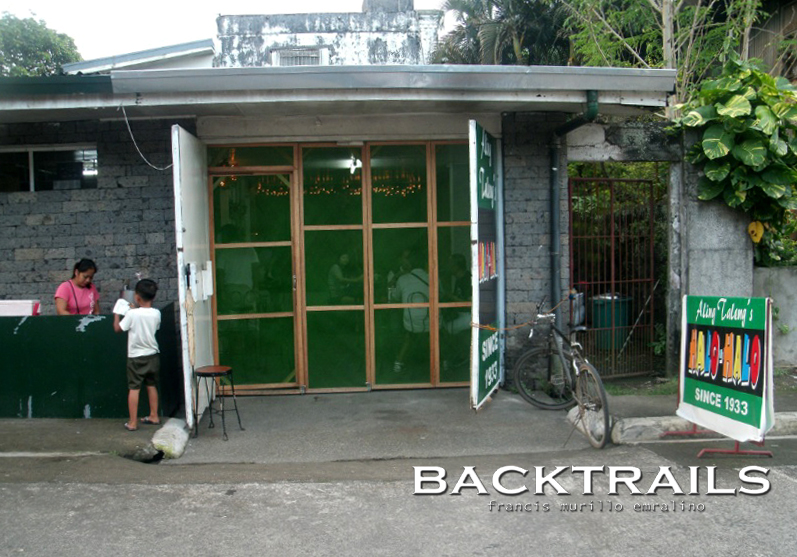
* view of the store from the outside

Traveling necessitates rest and food. And what’s better than sampling the local delicacies of thwe place you are visiting? For the town of Pagsanjan in Laguna, it has Aleng Taleng’s Halo-Halo. Claimed to have started in 1933 it is a place where you can find local food at reasonable prices. Of course, halo-halo is the store’s expertise but you can also try their noodle, seafood, and chicken delicacies. Whether you come in pairs or in big group, Aleng Taleng’s Halo-halo can accommodate you. 

* one bonus product we got in Pagsanjan: kesong puti,
a local delicacy found in the areas of Santa Cruz and Pagsanjan

[Where is Aleng Taleng’s Halo-Halo in Pagsanjan? The store is located at 169 General Luna Street, Brgy. Maulawin, Pagsanjan, Laguna. For inquiries you contact them at these numbers: (049) 501-7861, 0917-8998484, 0917-7578484.]

Saturday, January 15, 2011

Lakbay sa Lumban, Laguna

* gown for the bride? I wonder

* silhouette of the bridge in Lumban

* the municipal building of Lumban

The town of Lumban lies at the foot of the mountain ranges that stretch on the eastern side of Laguna. Lumban derives its name from a tree called lumbang. But I am yet to see for myself a tree called by that name.

Lumban also experienced division into different towns we now know as Sta. Cruz, Cavinti, and Pagsanjan. If you decide to continue traveling to the neighboring town of Paete, you’ll notice that a large part of Lumban is still open land for planting. Online reading informed me that two barangays – Kulyon and Binayuyo – are uninhabited. I wonder what can be found in these parts.

The town is also famous for its embroidered products primarily jusi and piña. To showcase the town’s prime products, they are holding an annual activity called Burdang Festival. They have rightfully earned the title Embroidery Capital of the Philippines.

* the church of Lumban

* the church’s interior

* Doric columns(?) found outside the church

Lumban Church

Lumban was once the heart of all missionary activities of the friars in the province. In 1578 Reverend Juan de Plasencia O.F.M. ministered in the town. The first church built there was only thatched and wooden. It was later destroyed by fire. Reconstruction of the town church marked the construction of the first stone church to be built in Laguna in 1600. On October 9, 1600 a Eucharistic procession was held. But earthquakes during the year 1880 brought much damage to the church.

From 1606 to 1618 a rest house was kept there to house the sick Franciscan missionaries. Also in 1606, a regional school for boys was put up by Reverend Juan de Santa Maria. About 400 boys were taught there liturgical hymns as w
ell as use of several musical instruments.

* tower for a cross?

* an unlikely feature in the church’s vicinity: a tennis court!

Places Yet to be Visited

Lake Caliraya, for one. I was earlier confused about this lake for I thought it is found in Cavinti, Laguna. I have once visited the Japanese Garden there and I hope to share it here next time. There is also the Talahib Falls although I am yet to find out how to get there.

Sunday, January 2, 2011

Revisiting Pagsanjan, Laguna: The Houses in Mabini Street III

* a maroon one

* the Pagsanjan Academy

* simply elegant

* phallic-looking one: a chimney of one of the houses there; although I am not so sure if this was a bakery

* half-wood, half-concrete

* a simple one

* a cozy one

* I simply love the windows

* another look at the Puerta Real, as we wait for a vehicle bound home

The last leg of my Mabini Houses series. I cannot help but look forward in visiting places that has a treasure of houses like these. Perhaps Vigan or the provinces in the Visayas area.

Saturday, January 1, 2011

Revisiting Pagsanjan, Laguna: The Houses in Mabini Street II

* view of a particular house ruins I have shared already

* simply beautiful

* standing gallantly!

* not from the Spanish era but definitely has an old look and feel to it

* American or post-American?

* I am always captivated by houses (whether new or old) that has driveways like this

* a piece of woodwork (an artwork? a bench? or simple a junk?) I found along Mabini Street

* yellow-colored one

* found just beside a small waterway

* old stone benches made in 1939

A happy new year to you, dear reader. This is just a continuation of the entry series about the houses in Pagsanjan, Laguna; particularly in Mabini Street. I entertained the idea of reducing these pictures to four houses per photo. But I went against this idea. These old houses deserve to be seen. They should serve as real world textbook pages to us; we have a culture that is in constant need of attention and cultivation. Will wrap up this series on the next entry.

Tuesday, December 28, 2010

Revisiting Pagsanjan, Laguna: The Houses in Mabini Street I

* a mixture of modernity and a touch of the past

* a typical renovated house;
on the ground floor is Infinito (whet
her it was a shop or a store I cannot recall)

* the local Iglesia Filipina Independiente

* an old arch along the street

* only the solid walls remain of what could have been a grand house

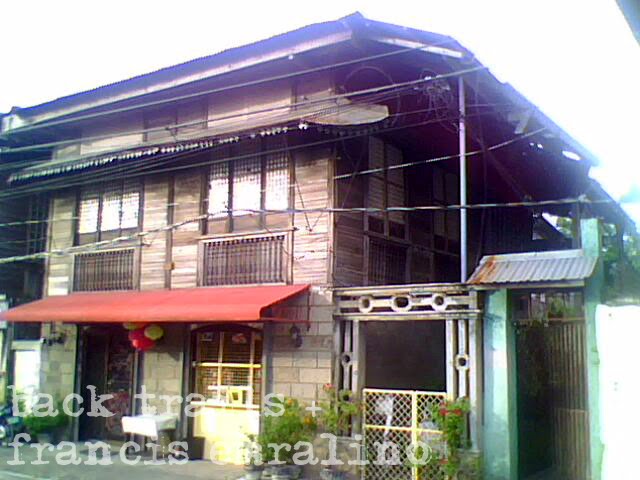
I have walked again into Wonderland. Or to make use of a more common phrase, it was as if I have walked back to the past. It is always, and I say always, wonderful to find myself surrounded by these houses that derive their designs from the Spanish period.

They are already relics, and these houses in Pagsanjan are part of that few remaining treasure houses in the country. They should be protected and preserved. In this country where weather phenomena are bound to wear every thing exposed to the environment, we cannot hope to find security by just owning them. Preservation methods should be done to them.

* elegant, as far as I see it

* strong and brick-colored

* still looking strong and elegant

* a haggard- and harassed-looking Trailer Pransis posing outside the house previously shown


* despite finding the Mabini Street just adjacent to Rizal Street which is always busy and noisy with vehicles, the street is surprisingly quiet

I admit I envy those who own such houses, as in the case of a brod in an organization Michael ‘Mike’ Asinas in San Pablo City, Laguna (see his house here). Passion for such colonial houses combined with the aptitude for preservation and the arts would surely enable these houses to survive and meet the future generations.

It is important that they survive I believe. For in these web-pervaded times, people’s attentions are shifted towards things online. And with the way Western culture permeate even our smallest activities; we really should have objects to which we Filipinos can call back our origins, our roots.

Such houses can be of immense help to us.

Monday, December 27, 2010

Revisiting Pagsanjan, Laguna

We recently did a four-town tour here in Laguna: Paete, Kalayaan, Lumban, and Pagsanjan. Pagsanjan was not in our list actually but the place was simply irresistible. Besides, visiting three towns in a day was already a tiring activity; Pagsanjan was certainly a good place to rest…and sip a cup of coffee.

Another motivation for revisiting Pagsanjan was a comment posted on one of my Pagsanjan entries. In it, someone suggested to me that I visit Mabini Street. It turned out that Mabini Street was just the street adjacent to Rizal Street, the one I have recently blogged about. The revisit was worth it.

[I will just share two finds here, as we were primarily in need of a comfort room and a place for rest when we arrived in Pagsanjan.]

* standing against the fiery sun

A Curious Obelisk

I did not notice this solitary monument until I took a picture of a statue of Father Pio on the far side of the Pagsanjan church’s patio. It seemed at first that it was a monument for Rizal. But no; he has his own at the town plaza. Neither did it look like a monument for World War II veterans. They have their own at the town plaza too.

And so I contented myself in observing the inscriptions on its base. I noted two plaques bearing the following words:

MORET CREADOR _ _ _ AS JUNTAS DE REFORMAS ULTRAMARINAS 1869
and..
MAURA AUTOR DEL R.O. DE 19 DE MAYO 1893.

Using an online English-Spanish translations program, these can be translated roughly as

MORET CREATOR _ _ _AS BOARDS OF REFORMS OVERSEAS 1869
and…
MAURA AUTHOR OF THE R.O. OF 19 OF MAY 1893

Who are these people and what are those boards mentioned are topics that can be studied next.

* the Pagsanjan Municipal Building, again!

The Pagsanjan Municipal Building

Alas, I was able to take some notes about the town’s municipal building. It was erected in mid-19th century and originally accommodated the Tribunal del Gramio de Naturales. Key points in our history saw the building’s occupation: first by the Filipino revolutionists in 1898 (Philippine Revolution of 1896), then by the American Forces in 1903 (Filipino-American War). The first public high school in Laguna was founded there in Pagsanjan and it served as its building from 1903-1907. It was most likely under the influence or administration of the Americans (or American educators for that matter). Then it also housed the town’s elementary school until 1911. Later, it became the office of the municipal government. The tumultuous times of World War II resulted in its destruction on March 20, 1945. The building’s reconstruction spanned four years: from 1951 to 1955.

---

Again, what remains to be seen in this town is the Pagsanjan Falls.

Sunday, November 21, 2010

The Falls Town: The Houses on Calle Rizal (Calle Real) 2

* an archway of the past

* in faded pink

* side streets in town maintain the look of an old Spanish town

* only the front pillars remain; feel free, dear reader, to imagine what the house looked like when it was still whole

* gives one an ancient feel; this one is literally covered in greeneries

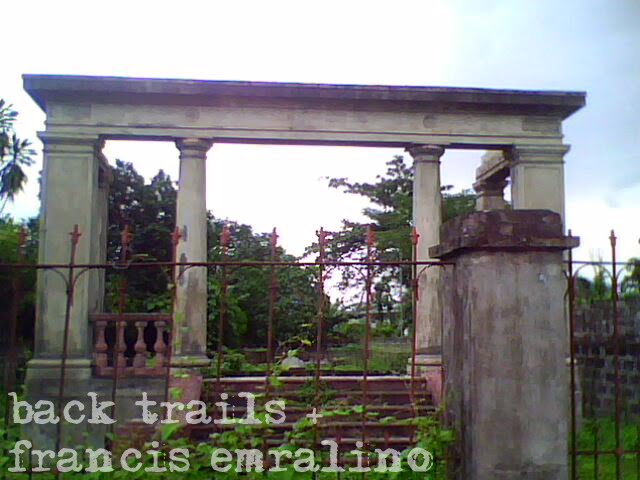
This is just a continuation of the last entry. We can see here the other houses along Rizal Street in Pagsanjan. What’s good about the place is that they keep the remnants of houses that once stood whole along the street. You can find ancient-looking archways, pillars of what looked like elegant houses before, among other. Perhaps besides the passage of time (which brought along with it natural phenomena that probably contributed to the wear and tear of houses, such as typhoons), I speculate that it was World War II that brought destruction to most of the houses there. The church was not spared during the war. How much more the houses that could have been easy targets for the enemies?

* surviving stone works

* a beauty!

* I took a fancy with that thing on the lower right - a waiting shed with a pointed hat on top

* old yet still pleasing to the eyes

* the concretes are what usually remains with the passage of time

* again, a beauty

Again, I feel bitin in sharing things here about Pagsanjan. I am left with names and events that are ready for research (adding to the piles of data I’ve gathered in my tours). The visit to places is always a start. But then, learning about places is a huge task. Let these short blog entries suffice for now. I believe I can elevate the nature and process of sharing details here in Back Trails. Finally, let me share here some random shots.

* Pagsanjan Public Market at dusk
* Pagsanjeños making last-minute purchases before night falls

I was still not able to make a search about the bodies of water in Pagsanjan which could be the possible place or places of inspiration for the name. Well, I hope I could finally share it here after my visit to Pagsanjan Falls. Kelan kaya ‘yun?

Pensees: One thing I am probably missing in my tours is the food products of the places I visit. Better make a series of entries about Philippine food and cuisine. Perhaps next year.