Saturday, May 14, 2011

Conquering Corregidor Island 7: The Mile-Long Barracks


The Mile-Long Barracks is perhaps one of the iconic landmarks in Corregidor Island. It was so named in reference to its length. But according to our tour guide, this particular barracks is actually shorter than a mile. This surviving structure gives evidence to the resilience of the materials used for it. It was said that Asano Cement from Japan was used for the structures in Corregidor; but I am yet to dig in for this particular detail.
 

Saturday, May 7, 2011

Conquering Corregidor Island 6: Parade Grounds of Topside


* the parade grounds at Topside* the set of guns displayed near the parade grounds at Topside

* wheeled gun

* gun mostly likely used for hostile planes of the enemies

* another gun* a surviving spring, of what (a gun, a ship) I don’t know


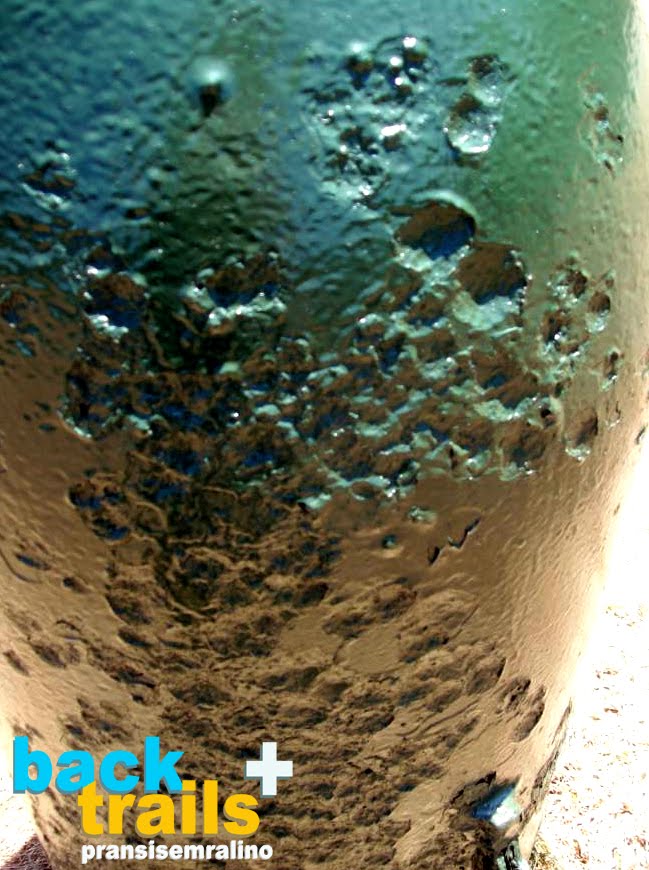
* a surviving bomb shell; a closer inspection reveal its durability having sustained only marks shown above

* Trailer Pransis manning a gun; he’ll make a poor soldier with that stance

To continue with my Corregidor Series.

The Topside apparently contained the important buildings of the American forces in Corregidor Island. A small plateau-like area serves as the parade grounds and the quarters of the soldiers stationed in the island at that time. On the parade ground we were able to see some of the surviving firearms used by the soldiers and a breath-taking, unobstructed view of the sky.

* Cine Corregidor

* Cine Corregidor’s box office

* view of what was once the outer structure of Corregidor* part of the façade of Cine Corregidor

* a look inside Cine Corregidor

Looking around, it seemed that the place was really meant for the fighters’ respite. Not far was the structure called the Mile-Long Barracks (pictures of which will be posted later), the Cine Corregidor, and the other quarters for the ranked soldiers and officers. Cine Corregidor has this architecture on its façade that recalls to mind the art deco style. Our tour guide said that the last movie to be shown there was “Gun With the Wind.” On my first visit, our guide spoke of the limitation of the cinema: only Americans can enter the place. This fact, I think, is debatable.

* The Bachelor Officers Quarters; the roman numeral above what could have been the door of the quarters says “1916 A.D.”, probably the year the structure was constructed

* another look at the Bachelor Officers Quarters

* the ruins of the Headquarters Building;
there was once a chapel
on the building’s second floor, the structure was built in 1915

* the Senior Officers Family Quarters

Across the cinema is the Bachelor Officers Quarters. I did an online search and was able to find the website corregidor.org. The website has a number of photographs of Corregidor and some of the structures at that time. I was able to see the Bachelor Officers Quarters in its pre-destructed state. See the photo here. (But I suggest that you visit the page about the “Lost Corregidor” here.)

* the grounds of Corregidor Island during the War was literally covered with trolley lines

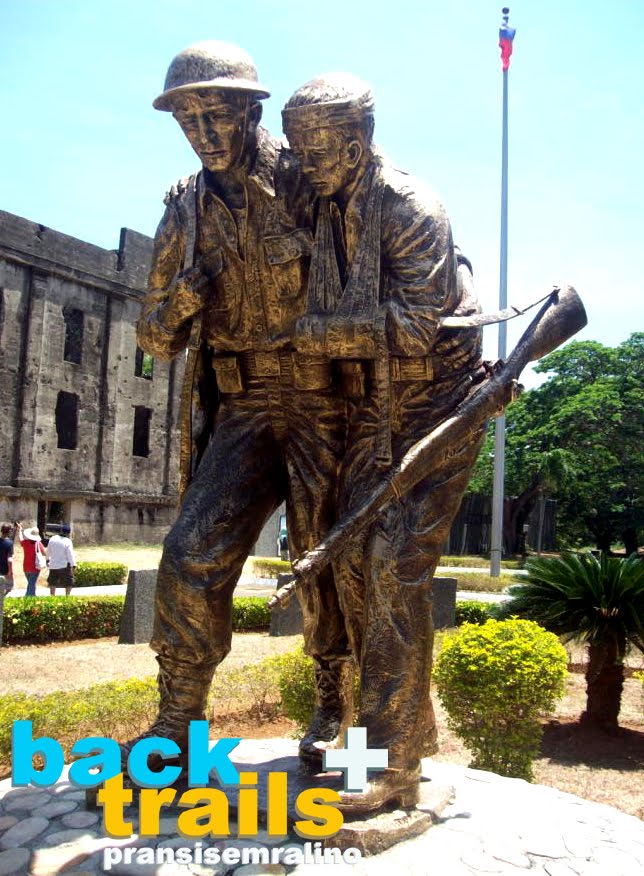
* this statue is the highlight of the Filipino-American Friendship Park; online reading reveals that this park was once located at the Middleside near the Corregidor Elementary School and the Middleside Barracks; why it was transferred to Topside is something I have to dig in

There were other recent additions on Topside such the Pacific War Memorial, the Pacific War Memorial Museum (I’ll be posting an entry about it later), and the Eternal Flame of Freedom. Too bad time constraints prevented me from re-exploring the Eternal Flame of Freedom. I was able to visit it during my first visit though but I was not able to snap a photo of the place in this second visit.

Friday, May 6, 2011

Conquering Corregidor Island 5: Spanish Lighthouse (Topside)


* the Spanish Lighthouse in Corregidor; the signboards point to different key cities in the world together with their corresponding distances from the Island

* the cell site tower?
* Trailer Pransis posing together with one of the towers in the Spanish Lighthouse area
 
* the patio

* the souvenir shops
* the souvenir items

The “head” of the tadpole-shaped island of Corregidor comprise the Topside area. Here, majority of the batteries were installed as well as other vital installations and quarters of the soldiers stationed in the island at the time of the War.

Found atop a hill in Topside, the Spanish Lighthouse gives one a commanding view of the seas surrounding the island and the neighboring Bataan Peninsula. The lighthouse was built by the Spaniards occupying the place in 1853. Later improvements were done in 1897 and much later by the American forces. It must have been lovely to be stationed at the top for the winds are fierce and the views are simply breath-taking.

* the room of the Lighthouse Keeper

* an apparent entrance to a tunnel (or bunker) found at the back of the Lighthouse

* view from the top of the Lighthouse; too bad I was not able to take a photo of myself

* from the top of the Lighthouse; the Mile-Long Barracks is partially visible and as well as the Bataan Peninsula in the background

* the quarters for the soldiers who brought their families in the island

Owing to its prominent position, the lighthouse was one of the structures completely destroyed by the Japanese in their attempt to capture the island. What is now enjoyed by the tourists is already a replica of the original one; the only consoling fact there is that the replica was reconstructed on the original site of the original lighthouse.

Today the site is composed of three towers, one for an agency concerned with sea travel, the other a cell site (if I am not mistaken), and the other is of course the Lighthouse. At the center is a patio surrounded by Spanish-type bungalows which house souvenir shops for the tourists.

Not far from the place one can find the quarters for the soldiers who had their families and a number of what looked like tunnels. There are indeed many things to discover in the island.
 

Thursday, May 5, 2011

Conquering Corregidor Island 4: Malinta Tunnel

* a map of Malinta Tunnel

* view of the Malinta Tunnel’s North Entrance which leads to the underground hospital
* Trailer Pransis posing outside the East Entrance

The Malinta Tunnel in Corregidor Island is perhaps one of the island’s most ingenious features. Found beneath Malinta Hill, the Tunnel is actually a network of sub-tunnels housing different quarters for the soldiers fighting during that time. All other tunnels connect to the main tunnel measuring 836 by 24 feet. The Malinta Tunnel was composed of the headquarters of General Douglas MacArthur, headquarters of the Harbor Defense, a 1,000-bed hospital, a gasoline storage area, a quartermaster’s area, and a series of lateral tunnels. There was also a navy tunnel connected to it.

The Tunnel has four major entrances: the North Entrance which leads to the hospital area; the East Entrance which leads to the Tailside area; the West Entrance which leads to the Bottomside area (and probably one of the most photographed part of the Tunnel); and finally, and this is a speculation, an entrance which leads to the Navy Tunnel.

* a replica of one of the guns in Corregidor being sold in a shop just outside the East Entrance

* some of the souvenir items being sold: ref magnets, t-shirts, and mugs

* another souvenir item: fish-shaped wallets!

President Manuel Quezon started out as the President of the Philippine Commonwealth, devised by USA for the Philippine Islands in 1939. At the outbreak of World War II, the country needed a leader more than any other time. He was thus sworn again as President (together with Vice President Sergio Osmeña) for a second term on December 30, 1941 outside Malinta Tunnel where the seat of the government was currently located.

Malinta Tunnel, of course, stood witness to the fiercest battles in the island, most notably the siege of Corregidor and the battles to retake the whole island during the latter months of the War.

* the first part of the lights and sounds show; a voice discussed what the presentation was about

* some of the dioramas being shown in the tunnel;
the lights and the voice-over gave life to these presentations
* a Philippine flag being raised as the National Athem was played in the ending part of the show

* Lateral Tunnel (15)

Today Malinta Tunnel and Malinta Hill are as silent as the seas surrounding them and now highlight sites for the visiting tourists. Malinta Tunnel is now home to a lights and sounds show entitled “The Malinta Experience.” This presentation was written and directed by Lamberto V. Avellana, a National Artist. On the ticket issued by the Corregidor Foundation, Inc. a subheading states that it was “his final tribute to valor, peace, and international understanding.” The ticket costs 100 pesos each.

The viewers for the show enter the East Entrance. The main tunnel now houses life-sized dioramas of some of the key events in Corregidor Island during the War. What makes it closer to the hearts of the Filipino viewers is the addition of the element of emotion to the dioramas, showing the loneliness that the fighting soldiers felt, the frustration, the hope that they would win the war. Beside the dioramas, there are also video presentations which hare actually footages taken during the war. In the end, the viewers are reminded of the purpose of what the soldiers fought for which was for freedom. Thus it was only fitting to end the lights and sounds show with the singing of the Philippine National Anthem. The viewers then exit through the West Entrance where a huge label of Malinta Tunnel can be seen. This, I think, is the most commonly photographed area to identify the place.

* a metal remnant of the War?

* this view gives one an eerie feeling of what it was like to live and thrive underground

* the West Entrance

In observing some of the tunnels, it seemed that some of the objects left there after the War were retained. Also, I saw that not all of the tunnels were renovated, particularly the lateral tunnels. For those who are availing the overnight package, I think that they are treated to a night visit to the hospital area where tales of ghosts and of the dead are the main themes. Yes, I would surely want to spend a night in Corregidor, even within Malinta Tunnel itself!